The CAS University Engagement Committee contacted Pauline Reimer, director at Pryor Associates, and invited her to write a blog post to provide interview tips for CAS Student Central members, that you can utilize as you embark on your early career.

As a seasoned, designated actuary as well as an experienced actuarial recruiter, I advise trainees to be prepared for the following most common questions asked on an actuarial first job interview in the property and casualty industry:
1. Tell me about yourself.
The purpose of this question is for the interviewer to get an initial view of your communication and interpersonal skills. First, summarize the highlights of your resume, then outline several skill sets that would demonstrate your ability to perform well. Refrain from speaking about family, friends, pets, etc.
2. Why do you want to be an actuary?
Most actuaries enter the field because of their passion for mathematics combined with their interest in business, data analytics, modeling and finance.
3. Why are you interested in the property and casualty industry?
Focus on the fact that the property and casualty industry involves hundreds of varied and interesting lines of business as well as emerging issues that are ever-changing and can affect the public on a daily basis (e.g., self-driving cars, catastrophic events, terrorism, identity theft, etc.).
4. What is your ideal job?
Stay on target with the position you are applying for. Make sure your input matches the job description, company size, and location. Include that you’re seeking a company supportive of the actuarial examination process.
5. What is your best/worst attribute?
For best quality, without sounding boastful, emphasize attributes (yes, it can be multiple!) that speak to your ability to get a job done under almost any circumstances, e.g., dedication, persistence, attention both to detail as well as the big picture, ability to work independently or part of a team, etc.
For worst quality, either select an example that won’t adversely impact your job performance [e.g., bad penmanship or poor spelling (adding “that’s why I always use spellcheck”)] or talk about a skillset that you are competent in but would like to enhance. Always inject a positive spin if you are mentioning a negative quality.
6. What is your biggest accomplishment?
Try to select an achievement from your personal or business life that is not obviously listed on your resume and reflects something that an employer might value (e.g., I maintained a 3.9 GPA while working 30 hours per week, attending classes full-time, and graduating in 2.5 years).
7. What is your biggest disappointment?
This could also be personal or professional, but should be one that does not impact your current ability to be successful on the job. Avoid citing failed actuarial exams as your example.
8. What do you know about our company?
Conduct research on the organization’s financials, products, history, and marketing. A good source is the company 10K which would also include a management discussion of the short and long term goals of the organization. Investigate interviewers’ backgrounds by using LinkedIn, but don’t initiate connecting with them.
9. Why should we hire you?
This is your opportunity to sell yourself (without sounding pompous)! Reiterate your strengths and cite examples of how the company could benefit by hiring you.
10. Why do you want to work here?
Remark on why you are interested in this particular company, job description, and location. Sound enthusiastic about the company’s culture, reputation, and opportunities available to you.
Additionally…
Prepare at least 5-10 questions about the organization. Ask predominantly business-related questions that reflect on your intellectual curiosity and business acumen. Don’t ask questions whose answers can be found by reading the company’s website; instead ask questions that embellish on some facts you researched. If interviewing at an insurance company, inquire which of their lines of business are the fastest growing, which new products or regions they plan to expand into, how their financial results for the current year compare to projected, etc. Forgo asking questions that will not impress an interviewer (e.g., work life balance or benefits questions).
Pauline Reimer, ASA, MAAA, has directed the Actuarial, Modeling & Risk Division of Pryor Associates since 1986, after working as an actuary herself. Named a top recruiting firm by Dun & Bradstreet, Pryor has 45 years of insurance (P&C, Life, Health, Pensions, Investments, Catastrophe Modeling, Predictive Modeling, and Risk Management) placement experience.
Pauline is a CAS Centennial Partner, on the SOA Entrepreneurial Actuaries Section Council, Executive Board of ASNY, and advisory boards of Columbia University’s and New York University’s Actuarial Science programs. Quoted in periodicals and television, Pauline handles each step of every actuarial and risk assignment personally.
Her impressive placement record of 99% retention rate and retained search success ratio confirm her status as one of the most successful recruiters of actuaries and related professionals worldwide. Her motto “It Takes One To Know One … An Actuary Placing Actuaries (and Related Professionals)” seems to describe this best.
Pauline can be reached at pauline@ppryor.com or 516.935.0100×307.

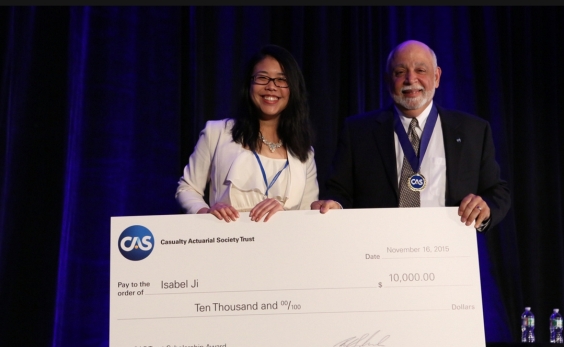
 For more than a decade, the CAS Trust Scholarship has been awarded annually to post-secondary student leaders dedicated to a career in casualty actuarial science. I am grateful to have been selected as one of this year’s winners and thrilled to have been offered an invitation and all-expenses-paid trip to the 2016 CAS Annual Meeting in Philadelphia, on top of the hefty $10,000 check towards my university tuition.
 The Actuarial Students National Association (ASNA) is a student-led organization that was established by three individuals in 1990. It has now grown to include fourteen universities as member organizations. Our primary goal is to provide students a larger resource base, keeping them abreast with industry knowledge while they attend university, and to foster a dialogue between the member universities and professional organizations.

 The CAS University Engagement Committee contacted Actuarial Careers, Inc., and invited them to write a blog post to provide you with tips on how to successfully advance through an interview process. We thank Actuarial Careers’ Robyn Taylor, Senior Vice President, for writing this post to share with members of CAS Student Central.
 e diverse number of career paths that an actuarial student can consider after college can seem daunting. A student must first weigh consulting versus company work and then consider whether Property & Casualty, Health, Life, or Pension work is right for them.
 I didn’t dream about becoming an actuary when I was growing up. I didn’t research it as I was applying to colleges. I didn’t even plan on it when I started college. However, once I discovered the career a year into college, I decided that it was the path I wanted to pursue. Learning that my school didn’t have an actuarial science program seemed to pose a challenge at first, but I learned that by getting involved in on-campus activities, I was able to gain experience and skills that would identify me as a well-rounded candidate and make me marketable to an actuarial employer.
 In 2006, I partook in the creation of an online company,

 Early in my career, people would often ask me how I ended up on my specific career path as an actuary. As a freshman studying Actuarial Science at Ball State University, I took a very active role early on in Gamma Iota Sigma, the International Risk Management Fraternity. I went to every employer campus presentation and signed up for every interview. Unfortunately for me, I didn’t end up with an internship that year; but, I was able to get a feel for what companies had the most interesting internship programs, were in attractive locations, and had the most engaging actuarial staff and recruiters. I based my list of preferred companies on these types of factors because I didn’t yet know what the work would entail.
 As insurance and regulation needs of companies continue to evolve, the role of a consulting actuary is becoming increasingly important to business. In addition to corporations, consultants work with insurance companies, government entities, healthcare entities and regulators. Consultants will often work directly with CEOs, CFOs and risk managers, who are concerned with minimizing the risk of their company and doing so at the optimal price. Some consultants may frequently travel to meet with clients locally, nationally, or even internationally. Typical assignments involve loss reserving and forecasting of insurance losses, especially those losses which are retained by a company. Projects may also include allocations to business units, reviewing excess or reinsurance quotes, determining confidence levels, and helping with the formation of a captive. Consulting actuaries are increasingly being engaged to complete more Enterprise Risk Management, strategic planning and predictive modeling assignments.
 One of the strengths of the actuarial profession is its willingness – indeed, its desire – to welcome and accommodate people with very different backgrounds. In our roles as identifiers, quantifiers, and managers of risk, actuaries benefit society by utilizing the variety of perspectives and approaches to risk that diversity provides.