

5 Tips for Starting your Actuarial Career
The CAS University Engagement Committee contacted DW Simpson, and invited them to write a blog post to provide you with information and tips to help you with your search for an actuarial position. We thank DW Simpson’s Adam Noreen, Actuarial Recruiter, for writing this post to share with members of CAS Student Central.
Over the past three years working as an actuarial recruiter, I have successfully assisted numerous entry-level actuaries in securing their first full-time positions. Here are my five tips for successfully making you a more marketable candidate:
1. Pass at least one actuarial exam
 This may be obvious to many, but your first barrier to entering the actuarial field will be completing at least one actuarial exam. Just about every full-time actuarial opportunity is going to require a minimum of one exam passed, and you will be even more marketable with 2-3 under your belt.
In the United States, companies tend to want a good balance of actuarial exams and hands-on experience, so I do not suggest passing more than three exams, prior to securing your first full-time position. after three exams, it can sometimes pose a challenge for hiring teams as far as how they can fit you into their compensation structure, which is often organized around a balance of exams and experience.
2. Seek actuarial internships
 Regardless of being a current student, new college graduate, or career changer, actuarial internship experience will be a valuable addition to your background. I recognize that most internships are offered to current college students. However, on several occasions, I have worked with career changers who have been able to secure internships, even 10+ years out of college. While many internship descriptions may list “must be a current college student,” this is not always the case; it is still worth putting in an internship application, if you have the time, as you never know when a company may have flexibility. Keep in mind that most actuarial internships will also require at least one actuarial exam passed.
3. Sharpen your technical skills
 Just about every actuarial job description that you review is going to include a combination of programming/computer skills. While Excel tends to be the number one utilized computer skill in the actuarial field, basic Excel skills are not really going to cut it anymore, if you want to be competitive. In addition to Excel, there tends to be quite a bit of demand for the following skills: Access, Visual Basic/VBA, SQL, SAS, C++, and R.
If you are a current college student, it may be worth including some Computer Science courses as electives, so that you can gain a bit more programming knowledge. On the flip side, if you are fresh out of school (or a career changer), and you feel that your technical skillset is not up to par, I suggest taking the time to gain a basic working knowledge of as many as the above skills as possible. You do not necessarily need to be an expert with each of these skills, but it will be quite valuable to have a foundational knowledge of each skill. Doing some basic internet searches will yield many free and paid resources.
4. Tailor your resume and cover letters
 It is quite common for job seekers to write a cover letter template, switch out the company name and position title, and click “submit.” This is a missed opportunity to explain your specific interest in the company and role, and hiring teams may see this as a lack of effort and interest. Do some research, and explain why this company and position make sense for you, long term.
In terms of resume formatting, I suggest keeping it clean and simple. Flashy fonts and colors may distract the individual who is reviewing your resume. Rather than spending time on creative formatting, put your efforts into including as much specific information as possible, in your resume, about your actuarial exams, computer skills, education, actuarial or related work experience, etc. I also strongly suggest including any work experience that you may feel is “irrelevant.” Perhaps you are working at a coffee shop or as a tutor. Either way, adding this information serves two purposes: it shows that you can multitask (especially if you are working during school and taking exams at the same time), and it also fills out any potential employment gaps that would otherwise be there if the experience was not outlined.
5. Prepare to interview
 One of the most common reasons that candidates do not move forward after an initial phone interview is that they did not appear to be knowledgeable about the company and position they are interviewing for. Make sure to thoroughly review the company’s website days before your interview, and print out a copy of the job description to have handy for your interviews. Take the time to draw parallels between your background (academics, work experience, technical skills, etc.), and the role you are applying to. It may also be helpful to write out a list that answers “Why am I interested in this specific company and role?” and also “Why am I a good fit?” Make sure to know the lines of business that the company works with.
Prior to the interview, I suggest searching the internet to see if there has been any recent news about the company you are speaking with. If there is anything particularly positive (recent awards, new exciting products, financial successes, etc.), it is always impressive to be able to cite the recent news as a reason to why you are very interested in the company. The key is to really do your homework on each company you interview for.
 Adam Noreen is an Actuarial Recruiter at DW Simpson. He has been assisting entry-level candidates and career changers for approximately three years, in securing their first actuarial and analytics positions. Contact Adam at adam.noreen@dwsimpson.com

 Suddenly, you see something, just ahead and to the left, on the periphery of your screen sensor. You instinctively shift your direction slightly, and slowly close in on the object. You switch to virtual camera mode — and there it is, standing over six-feet tall: a bi-pedal feline. Right in front of the window of a well-landscaped brick ranch home, just standing there like he owns the place. Not believing your luck, you blink and then refocus. Your eyes were not deceiving you. It is indeed one of the rarest (and strongest) of the Pokémon: Mewtwo. You simply must have it! But before you attempt the capture, you’d like to get much closer…
 You throw open the unlocked gate and step into the yard, breaking your ankle on a loose cobblestone. Undaunted, you limp purposefully toward the Mewtwo, trampling several expensive flowers and small ornamental shrubs. You fling your Pokéball, and score a direct hit – the Mewtwo is yours! In your ecstasy, you raise your arms in triumph, accidentally letting go of your phone, which flies into and shatters a window on the home.
 Chase Yetter, a rising senior at Lebanon Valley College double majoring in actuarial science and mathematics, was this year’s recipient of the $10,000 CAS Trust Scholarship. “When I was a student in high school, I knew I wanted to pursue a career that would challenge me, and I wanted it to involve both mathematics and business,” said Yetter. Chase is excited about a pursuing a career in the property and casualty industry, and has already been able to attend multiple industry events including the Spring 2015 and Fall 2015 Casualty Actuaries of the Mid-Atlantic Region (CAMAR) meetings, as well as the 2015 CAS Annual Meeting as part of the student program. “I hope to quickly become a Fellow of the Casualty Actuarial Society (FCAS) and a Chartered Property Casualty Underwriter (CPCU)… I also hope to become one of the first to earn the predictive analytics credential that arises from the partnership between the CAS and The Institutes.”
 Chloe Marshinski, a senior at the University of Illinois at Urbana-Champaign majoring in actuarial science and statistics, was awarded a $5,000 CAS Trust Scholarship. “Knowing my work is contributing to a field that helps our society function and grow gives me motivation and purpose in my work. I am specifically interested in the property-casualty industry because it encompasses so many different types of risk and is constantly faced with new challenges,” said Marshinski. She held an internship this past summer with CNA, where she completed two pricing reviews consisting of pulling and organizing data and making loss ratio selections, comprehensive pricing analysis of the umbrella book of business, and presented findings and recommendations on future business strategies to underwriting. Before that Marshinski interned with a State Farm agent, researching products, communicating with customers about their product interests, and calculating auto insurance quotes for online leads. Her internships taught her that “while the data and the numbers are important during an analysis, it’s being able to communicate your findings and recommendations to others that makes the analysis worthwhile.”
 Sarah Rumon is an actuarial science major and rising junior at University of St. Thomas. She was awarded a $5,000 CAS Trust Scholarship. Rumon is the founding member and president of Gamma Iota Sigma Beta Pi Chapter at University of St. Thomas and was International Student Representative for Gamma Iota Sigma at the annual Gamma Iota Sigma Conference last year. Rumon has also taken part in the Travelers Insurance Actuarial Summer Student program as well as their Actuarial and Analytics Leadership Development Programs, where she summarized and presented aggregate review results to loss analytics department, and gained an understanding of public sector products. “During the course of my education and professional experiences thus far, I have come to realize that being an actuary is so much more than passing tough exams and being skilled with using Excel. To me, a successful actuary has three distinct sets of skills: analytical skills, business acumen and knowledge, and soft skills such as leadership, communication, time management, and more,” said Rumon.


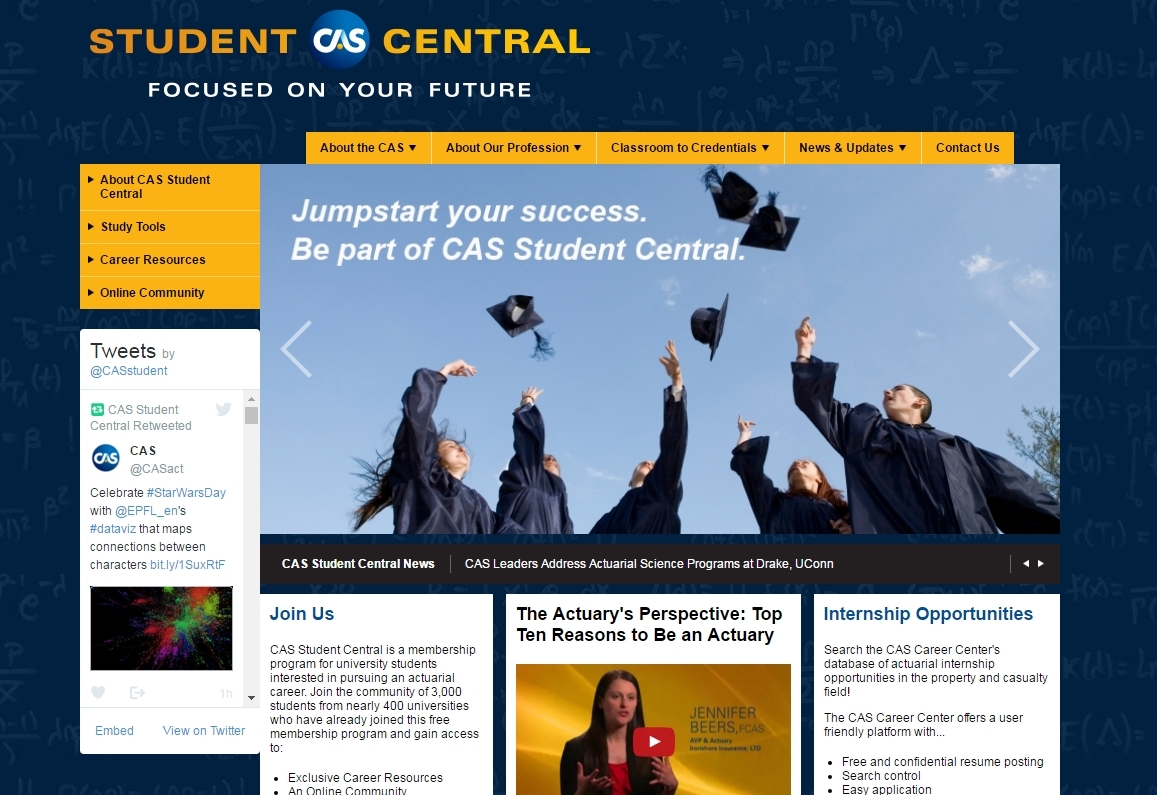
 Two years since its inception, the CAS Student Central Program now reaches more than 4,000 student members from over 400 universities worldwide! The growth of the program can be attributed to the wide range of benefits and resources made available to support you on your actuarial career path. We’ve highlighted a few of the key resources below, and we invite you to share your recommendations on additional materials or benefits that you’d like to see made available to Student Central members in the future!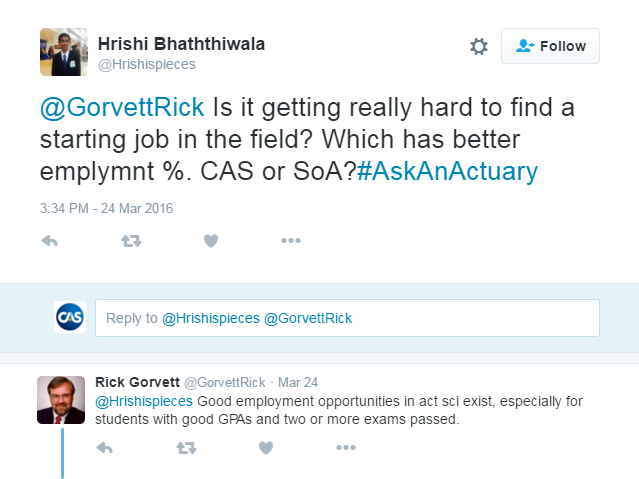







 The CAS exam process provides aspiring property and casualty actuaries with a solid foundation in insurance and actuarial topics. But how can university students, candidates, and credentialed actuaries stay informed and up-to-date on the latest industry trends?
 We thank Syed Danish Ali, for sharing this post with members of CAS Student Central. A version of this post was originally on the University of London’s student blog.
 A year ago I was an international student studying at the University of Toronto. I am from China, and I decided to pursue my dream of becoming an actuary in Canada six years ago. There are lots of exciting opportunities there, but as I embarked on my job search, I realized that there were cultural and language gaps that presented unique challenges for international students searching for actuarial jobs in either the United States or Canada.

 RESUME DON’TS
 MARGI PATEL, Actuarial Recruiter