10 Things to Consider Before Landing Your First Actuarial Job
 Ever since I began my career as an actuary, I’ve been passionate about helping students navigate the uncertainties of their initial job search. Choosing a path after college is already difficult, and once you’ve chosen to go down the path of a career as an actuary, the question becomes, “how do I get my first job?”
As I searched for my first job out of college I remember wishing that I could read the minds of my potential employers. I knew that preparing for an interview was important. I wanted to know exactly what the employer was looking for and how I could meet their requirements.
Based on my experience recruiting for both of my companies and speaking with many candidates, here are my top 10 things you should consider as a student that will bring you closer to getting that first job as an actuary – ranked in no particular order of importance. As a member of the CAS, my list is based on my experience as a property and casualty actuary, however these tips are transferable to a career in life and health.
1. Develop an understanding of the types of actuarial jobs available.
Know the job market. Consider the types of firms where actuaries work, including insurance companies, brokerages and consulting firms. Also, consider responsibilities actuaries hold at these companies, such as pricing, reserving and predictive modeling. Career fairs are a great way to see which companies are hiring, and give you chance to meet their representatives in person. You can impress during an interview by displaying you’ve done your homework and you understand the types of actuarial positions available.
2. Network!
 I cannot stress enough the importance of developing and utilizing your network, even at the onset of your career. Your network is likely much larger than you think – It’s made up of friends, family, university professors and other acquaintances. The better you get to know someone, the more likely you’ll be to have access to their network, which can vastly expand the number of people who can help you find that first job. If you have the opportunity to meet someone and make a new connection, do it! LinkedIn has made it easier to keep track of your network, however, remember that LinkedIn is not enough. You need to take the time developing connections. That means asking people to get coffee and staying in periodic contact with them. The more time someone invests in you, the more likely they’ll become an asset to you in your job search. I recommend keeping a spreadsheet with your network and keeping it updated with every interaction you have with a potential contact.
3. Develop a rudimentary understanding of the insurance business
Actuaries are traditionally insurance experts, so it makes sense to know about the industry in which you’ll likely be working. Take a look at the list of the largest property and casualty insurance companies, and read about them to understand the type of business they write. Are they writing personal lines, commercial lines, specialty lines or maybe all of the above? Read up on the standard insurance products – you might be working with them when you’re hired.
4. Pass exams in while in college
 It’s no secret that it can be challenging to obtain an entry level actuarial position without an exam passed. Nowadays, I’ve interviewed candidates that have passed three, four, or even five exams before looking for their first job. The more exams you pass while in college, the stronger your resume looks, and the easier it will be to obtain your fellowship, as you’ll need to pass fewer exams once you start working full time. I’ve heard students say that they have been advised not pass too many exams while still in school. I find that advice to be out of date and detrimental to applicants.
5. Keep that GPA high
The GPA isn’t the most important statistic on your resume, but a low GPA could give an interviewer a reason to doubt a candidate’s abilities. So stay focused on keeping those grades up!
6. Take advantage of soft skill opportunities
The actuarial career requires a unique balance of technical skills and communication skills. Many students studying to become actuaries focus on math and economics courses. These courses teach critical skills, however, you should consider opportunities to improve your soft skills. Classes to consider include ones that require writing papers, or public speaking courses.
7. Take steps to prepare for the interview process
An interview can be daunting for someone that hasn’t experienced one. Even someone with a spotless resume can stumble in an interview due to nervousness or lack of preparation. It is important to know your resume inside and out, learn about the company to which you are applying, and know the description of the position to which you are applying. You should find someone such as a career services professional to do mock interviews with. Professionals can help you diagnose weaknesses in your interview style and provide suggestions on how to improve your interview skills.
8. Make your resume spotless
Career services at your school can help by proof reading your resume. It is hard to imagine, but even a small typo will stick out like a sore thumb on a resume. Print out a copy of your resume and read through it. This will help you spot errors that you might have overlooked while reviewing your resume on the computer.
9. Understand the hiring schedules of companies for internships and full time candidates early on.
This is particularly important if there is a company you would really like to work for. It is important that you don’t miss a deadline to submit an application. To avoid this, you need to understand their hiring schedule well in advance. Most of the larger firms are beginning to hire earlier than they have in the past so they can fill out their entry level positions ahead of the spring graduation. Be prepared to submit your application earlier than you may think.
10. Flesh out your technical skills
It’s a huge plus to be able to showcase relevant software knowledge on your resume. Consider taking an introductory course in Microsoft Excel, which is the bread and butter software used by actuaries. Additionally, look for opportunities to get experience with VBA, SAS, SQL, R, Java or other programming languages. If you can demonstrate in your interview that you have experience with one or more of these languages, it will suggest to the interviewer that you’ll have a head start on important skills when you begin your full time role.




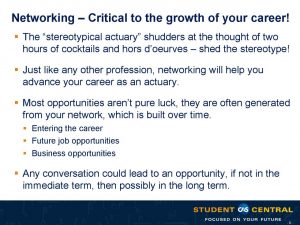 Phil Natoli, a Fellow of the CAS and member of the American Academy of Actuaries, manager in insurance and actuarial advisory services at Ernst & Young, went over the importance of networking. Natoli focused on how to establish your professional network by taking advantage of networking events offered by your school, local employers, and Student Central. He mentioned to always keep in mind that any conversation could lead to an opportunity, if not in the immediate term, then possibly in the long term.
 CAS staff actuary Rick Gorvett, Fellow of the CAS and Former Chair of the Actuarial Science Department at the University of Illinois at Urbana-Champaign explained how to effectively research companies. Some of Gorvett’s tips included tapping into other’s personal experiences, navigating through the company website and where the most pertinent information can be found, and researching recent news articles on the company. He also went into more detail on how A.M. Best’s Insurance reports and SEC 10-K report can help guide your search.
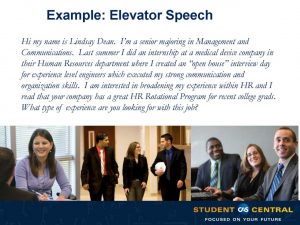 Lauren Fitzgibbon, senior campus recruiter at Liberty Mutual Insurance shared tips on getting the most out of career fairs and how to prepare your resume. Fitzgibbon’s advice covered how to stand out at a career fair by creating an “Employers I Want to Work For List”, having a 60 second elevator pitch ready, and she provided a Do’s and Don’ts to keep in mind while at the fair. She also shed light on what recruiters want to see on your resume, what things to highlight, what words to avoid and how to use your career services office if your university has one.
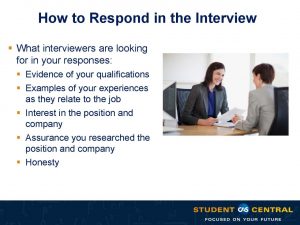 Helen Simonett, personal lines pricing actuary at Travelers, and a Fellow of the CAS went into detail on how to hone your interview skills. Simonett started with helpful tips on researching the company, being able to speak to everything on your resume, and preparing questions for the interviews. She went into further detail on what interviewers are looking for in your responses, what questions you might be asked and how to respond, and what questions to avoid asking.

 Communication – Interpersonal and intrapersonal communication are essential in this field. Once someone understands a complex actuarial concept, it is then their duty to be able to communicate these results and conjectures to their coworkers, managers, and other departments. To develop this skill, I recommend just getting out there and talking to people. If an opportunity to teach a class or give a presentation arises, jump on it- practice makes perfect!
 Do Your Research – What is an actuary, and why do you want to be one? Do you know the differences and similarities between consulting and industry? Investigating this information through speaking to professors and people currently in the industry is a great way to figure things like this out. Additionally, there are online resources like CAS Student Central, Actuarial Outpost, BeAnActuary and other forums dedicated just to educating you.
 Study Smart – By collaborating with peers, studying becomes a lot more beneficial. Locking yourself away in a silent cubicle can lead to a lot of frustration and misunderstandings. Working through problems with peers and discussing difficult concepts often leads to a better understanding for all parties. Additionally, check out online study tools like Coaching Actuaries and The Infinite Actuary to optimize your exam preparation techniques.
 Network – If you’re in school, and your school has an Actuarial Science Club, join it. Your peers are going through similar triumphs and struggles, and this comradery can offer a great support system. Additionally, attending recruitment or informational conferences, company presentations, and even meeting digitally (i.e. LinkedIn or forums) can lead to interpersonal connections in which you can leave a lasting impression on a recruiter and learn about what they do. Sometimes, who you know becomes more important than what you know.
 Programming – If there is an opportunity to learn more information about programming or data, take advantage of it. For example, this semester, I heard about a business class at my school teaching information about data analytics, IT, and a brief introduction to Super interesting! Often, similar opportunities exist in our lives but may not be mandatory or well-known—find them, and try them. There are also many online resources for programming; just hop on your favorite search engine.
 Time Management – Think critically about the best way for you to manage your time. Some people may utilize an online calendar and scheduling tool, but keeping a physical planner or calendar might work best for you. When studying for exams, know when the next sitting is and be sure to sign up far in advance to get your ideal time slot and location. Studying for an exam takes a lot of dedication and time management, especially when done in conjunction with work and/or school.
 Diversity – Our world is a very diverse place, and you will work with people of different races, genders, sexual orientations, ability statuses, religions, nationalities, and ethnicities than you. Knowledge about inclusion and social identity goes a long way, especially when you’re able to integrate your knowledge into your everyday interactions. Working with a diverse group of people brings forth a mélange of new ideas and can propel your work to a new level.
 Know How to Use Prometric-Permitted Exam Calculators – Having to calculate a bond yield or the present value of an annuity on a TI-30 can be emotionally and physically exhausting. When you have access to a BA-II Plus, calculating these values becomes a lot easier. However, you have to know the right sequence of buttons to press and more. I suggest using only Prometric-permitted exam calculators when studying for actuarial exams. If you find that financial calculators are difficult to navigate, YouTube has great tutorials for the BA-II Plus!
 Have Fun! – While we have a long road ahead of us, it is important to take some time to be a human. Spending a night with friends after a long week can be a great way to recharge and take care of yourself. Joining a fun club, community organization, or volunteering can give you some time to relax, reflect, and do good.