Three New Year’s Resolutions for Actuarial Students
The beginning of a new year is often a time to pause and reflect – in both directions, forward and backward. We look back at the calendar year just completed, and we can’t help but try to recall its major events, assess how good or bad it was, and evaluate its general impact on our lives. Such reflection is a good thing – especially if it encourages us to learn from the past, identifying and responding appropriately to both the good and the bad.
But when it comes to a New Year, mostly we think of resolutions: those plans and promises we make to ourselves regarding the future (e.g., from my personal resolution repertoire: losing weight, getting better organized), and which often last far shorter than originally planned (e.g., again from my personal resolution experience: 24 hours, and ditto).
Despite occasional failures to live up to our plans, the idea of a resolution is a good one, whenever it is made. And so I herein offer three possible resolutions for actuarial science students: three recommendations for habits and behaviors that will help you to better develop your business skills and actuarial persona. And these are non-technical resolutions. In our actuarial world, it is easy to let the pursuit of technical skills overwhelm us: taking university courses, preparing for actuarial exams, learning a new programming language. But full and ultimate success in a career is, I believe, at least as dependent upon the softer, or non-technical skills, as it is on the technical. And to have both technical and non-technical skills – that’s a recipe for well-rounded success.
Here are three non-technical resolutions for actuarial science students – resolutions that you can begin implementing now, and continue for the rest of your career.
 1. Begin or Enhance Your Networking Efforts: All successful people network. Period. And there is always more networking one can do, limited only by the number of hours in a day, the need for sleep, and other such minutiae of life.
“Networking” is the systematic development and nurturing of relationships to fulfill certain needs or desires. From a career perspective, building such relationships can facilitate knowledge and opportunities, and it is something you should work on daily, throughout your career. And it is never too early to start. There are dozens of ways to network; just a few examples:
- If you read something interesting – e.g., an article, email, or blog post – send a quick message to the author expressing your appreciation and showing interest in the topic.
- When meeting someone new, consider following up with a brief phone call or email. If relevant and appropriate, ask if they’d be interested in talking further over a cup of coffee, or perhaps grabbing a sandwich for lunch.
- Keep a list or database of names, contact information, and a few important characteristics about each person.
 2. Become a Career-Long “Student” of Your Industry: Absorb as much information and knowledge of your industry / profession as possible. For actuarial students, right now that may mean learning about actuarial science and risk management in a broad, general sense; you can tailor your information-gathering efforts to your specific career focus (e.g., property / casualty insurance, health risk management, etc.) later, once you have made a decision on where to concentrate your career.
Nowadays, there are numerous “news aggregator” apps that allow you to collect, organize, and read information, by searching news articles and other media based on your selected key words. (Start with “actuary” and “actuarial,” and add other key words as desired.) Make a daily habit of perusing your aggregated news, reading a few of the links in-depth. Soon, you’ll have plenty of industry knowledge with which to better understand discussions, see connections between topics, or start your own cocktail party conversations.
 3. Subscribe To and Read a Newspaper: Sounds trivial, I know. But this is something I always recommend to near- and recent-graduates who will be starting their jobs and careers. Knowing a bit about what’s going on in the world – internationally, nationally, and locally – is an important indicator of your presence and engagement. And, more importantly, it will help you to better appreciate your life and the world around you.
Keep in mind that much of job and career success is a matter of engaging with others in conversation, and being aware of what’s happening in the world that might be notable or relevant to your industry. Small talk at the beginning or end of (or sometimes even during) meetings is not unimportant; demonstrate engagement and enthusiasm at every opportunity.
Best of luck – and Happy New Year!


 So after some paperwork, getting the Biometric labs done, some more paperwork, working with the movers, even more paperwork, working with the relocation services, and signing the contract on the dotted line, I was on my way.


 Ever since I began my career as an actuary, I’ve been passionate about helping students navigate the uncertainties of their initial job search. Choosing a path after college is already difficult, and once you’ve chosen to go down the path of a career as an actuary, the question becomes, “how do I get my first job?”
 It’s no secret that it can be challenging to obtain an entry level actuarial position without an exam passed. Nowadays, I’ve interviewed candidates that have passed three, four, or even five exams before looking for their first job. The more exams you pass while in college, the stronger your resume looks, and the easier it will be to obtain your fellowship, as you’ll need to pass fewer exams once you start working full time. I’ve heard students say that they have been advised not pass too many exams while still in school. I find that advice to be out of date and detrimental to applicants.


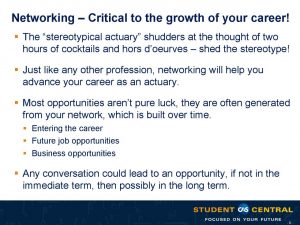 Phil Natoli, a Fellow of the CAS and member of the American Academy of Actuaries, manager in insurance and actuarial advisory services at Ernst & Young, went over the importance of networking. Natoli focused on how to establish your professional network by taking advantage of networking events offered by your school, local employers, and Student Central. He mentioned to always keep in mind that any conversation could lead to an opportunity, if not in the immediate term, then possibly in the long term.
 CAS staff actuary Rick Gorvett, Fellow of the CAS and Former Chair of the Actuarial Science Department at the University of Illinois at Urbana-Champaign explained how to effectively research companies. Some of Gorvett’s tips included tapping into other’s personal experiences, navigating through the company website and where the most pertinent information can be found, and researching recent news articles on the company. He also went into more detail on how A.M. Best’s Insurance reports and SEC 10-K report can help guide your search.
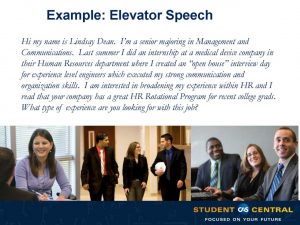 Lauren Fitzgibbon, senior campus recruiter at Liberty Mutual Insurance shared tips on getting the most out of career fairs and how to prepare your resume. Fitzgibbon’s advice covered how to stand out at a career fair by creating an “Employers I Want to Work For List”, having a 60 second elevator pitch ready, and she provided a Do’s and Don’ts to keep in mind while at the fair. She also shed light on what recruiters want to see on your resume, what things to highlight, what words to avoid and how to use your career services office if your university has one.
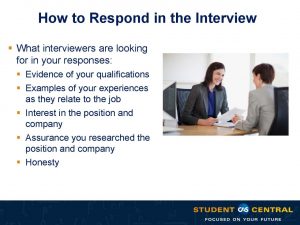 Helen Simonett, personal lines pricing actuary at Travelers, and a Fellow of the CAS went into detail on how to hone your interview skills. Simonett started with helpful tips on researching the company, being able to speak to everything on your resume, and preparing questions for the interviews. She went into further detail on what interviewers are looking for in your responses, what questions you might be asked and how to respond, and what questions to avoid asking.

 Communication – Interpersonal and intrapersonal communication are essential in this field. Once someone understands a complex actuarial concept, it is then their duty to be able to communicate these results and conjectures to their coworkers, managers, and other departments. To develop this skill, I recommend just getting out there and talking to people. If an opportunity to teach a class or give a presentation arises, jump on it- practice makes perfect!
 Do Your Research – What is an actuary, and why do you want to be one? Do you know the differences and similarities between consulting and industry? Investigating this information through speaking to professors and people currently in the industry is a great way to figure things like this out. Additionally, there are online resources like CAS Student Central, Actuarial Outpost, BeAnActuary and other forums dedicated just to educating you.
 Study Smart – By collaborating with peers, studying becomes a lot more beneficial. Locking yourself away in a silent cubicle can lead to a lot of frustration and misunderstandings. Working through problems with peers and discussing difficult concepts often leads to a better understanding for all parties. Additionally, check out online study tools like Coaching Actuaries and The Infinite Actuary to optimize your exam preparation techniques.
 Network – If you’re in school, and your school has an Actuarial Science Club, join it. Your peers are going through similar triumphs and struggles, and this comradery can offer a great support system. Additionally, attending recruitment or informational conferences, company presentations, and even meeting digitally (i.e. LinkedIn or forums) can lead to interpersonal connections in which you can leave a lasting impression on a recruiter and learn about what they do. Sometimes, who you know becomes more important than what you know.
 Programming – If there is an opportunity to learn more information about programming or data, take advantage of it. For example, this semester, I heard about a business class at my school teaching information about data analytics, IT, and a brief introduction to Super interesting! Often, similar opportunities exist in our lives but may not be mandatory or well-known—find them, and try them. There are also many online resources for programming; just hop on your favorite search engine.
 Time Management – Think critically about the best way for you to manage your time. Some people may utilize an online calendar and scheduling tool, but keeping a physical planner or calendar might work best for you. When studying for exams, know when the next sitting is and be sure to sign up far in advance to get your ideal time slot and location. Studying for an exam takes a lot of dedication and time management, especially when done in conjunction with work and/or school.
 Diversity – Our world is a very diverse place, and you will work with people of different races, genders, sexual orientations, ability statuses, religions, nationalities, and ethnicities than you. Knowledge about inclusion and social identity goes a long way, especially when you’re able to integrate your knowledge into your everyday interactions. Working with a diverse group of people brings forth a mélange of new ideas and can propel your work to a new level.
 Know How to Use Prometric-Permitted Exam Calculators – Having to calculate a bond yield or the present value of an annuity on a TI-30 can be emotionally and physically exhausting. When you have access to a BA-II Plus, calculating these values becomes a lot easier. However, you have to know the right sequence of buttons to press and more. I suggest using only Prometric-permitted exam calculators when studying for actuarial exams. If you find that financial calculators are difficult to navigate, YouTube has great tutorials for the BA-II Plus!
 Have Fun! – While we have a long road ahead of us, it is important to take some time to be a human. Spending a night with friends after a long week can be a great way to recharge and take care of yourself. Joining a fun club, community organization, or volunteering can give you some time to relax, reflect, and do good.