Start Your Actuarial Career Off on the Right Foot with These Exclusive CAS Student Central Resources
Two years since its inception, the CAS Student Central Program now reaches more than 4,000 student members from over 400 universities worldwide! The growth of the program can be attributed to the wide range of benefits and resources made available to support you on your actuarial career path. We’ve highlighted a few of the key resources below, and we invite you to share your recommendations on additional materials or benefits that you’d like to see made available to Student Central members in the future!


Access to Free Practice Exams

CAS Student Central teamed up with The Infinite Actuary to provide exclusive access to free practice exams on P and FM, beyond those already offered on The Infinite Actuary website.  Each problem on these full length sample exams offers a video solution to ensure that students have a strong understanding of the material. Typically these exams are only available to students through the purchase of an Online Seminar through The Infinite Actuary, however you can access this FREE resource on the CAS Student Central website.

CAS Student Central Webinar Recordings

Each semester we offer a webinar exclusively for actuarial students. The webinars are a great way for you to get advice on the actuarial profession and get a better understanding of the tools and concepts that actuaries use in their day-to-day work. If you haven’t been able to attend a Student Central webinar yet, or want to go back and revisit a webinar topic you enjoyed, you can access recordings of all of the webinars in the Student Central Online Community.

You can also download past webinars through the links provided below:

Invitations to Networking Events

Have you attended a CAS Student Program yet? The CAS offers student programs at five meetings and seminars annually. Attendees are invited to spend the day meeting and networking with practicing actuaries, and learning more about the CAS and P&C Industry. Check out the list of remaining programs in 2016. For details on registering for any of these programs contact Tamar Gertner, CAS University Engagement Manager.

  • CAS Spring Meeting, May 17, 2016, Seattle, WA
  • CAS Seminar on Reinsurance, June 6, 2016, Boston, MA
  • CAS Casualty Loss Reserves Seminar, September 19, 2016, Chicago, IL
  • CAS Annual Meeting, November 15, 2016, Orlando, FL

Additional opportunities may be available through your CAS Regional Affiliate. Visit the CAS webpage for the list of regional affiliates.

Online Calendar of Events

The Online Calendar of Events makes it easy for you to access important dates and deadlines relevant to actuarial students all in one place. The calendar lists upcoming actuarial exam dates, scholarships deadlines, webinar and in-person event registration dates and more! Notice an event or deadline that’s missing from the calendar? Let us know and we’ll make the update.

Internships

As the actuarial field grows more competitive, companies are increasingly looking for candidates that have internship experience. CAS Student Central provides you with a list of internship offerings available through the CAS Career Center. You can find relevant listings and sign up for automatic email notifications of new listings that match your criteria. Read the full list of features on the CAS Student Central website.

Search CAS Directory


Practical Advice for Students from Student Central’s TweetChat

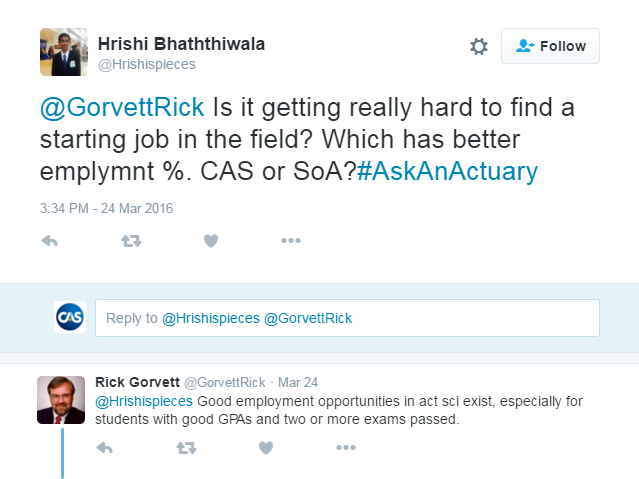
A few weeks ago, we held our first ever TweetChat with CAS Staff Actuary Rick Gorvett. Gorvett is a thirty-year veteran of the insurance industry and a longtime member of the CAS with a background in both corporate and academic practice.  Prior to joining the CAS staff, Gorvett served as director of the actuarial science program at the University of Illinois Urbana-Champaign. If you didn’t get a chance to follow the tweet chat, you can check out some of the highlights below.

Why Be An Actuary?

Q1.PNG 

RA1-3.PNG

RA1-4.PNG

The Creativity of Property and Casualty

Q2.PNG

RA2-2.PNG

Emerging Areas for Future Actuaries

Q3.PNG 

RA3-1.PNG

RA3-2.PNG

Beyond Math

Q4.PNG 

RA4-2.PNG

RA4-3.PNG

RA4-5.PNG

Starting Out in the Field

 Capture1.PNG

Graduate School

Q5.PNG

RA5-1.PNG

RA5-2.PNG

It was a great experience for everyone involved. We will have the entire TweetChat available for you soon. We plan on continuing to create new opportunities for you to interact with us and have an open dialogue with industry professionals to help you on your actuarial career.

Did you find the TweetChat useful? How else would you like to engage with us? How can we be a better resource? Let us know in the comments below!


Search CAS Directory


How Actuaries Stay Informed and Up-To-Date

The CAS exam process provides aspiring property and casualty actuaries with a solid foundation in insurance and actuarial topics. But how can university students, candidates, and credentialed actuaries stay informed and up-to-date on the latest industry trends?

The first place to turn to is the CAS, which produces a variety of publications. You may already be familiar with Future Fellows, the quarterly newsletter geared toward exam-taking university students and candidates.

Other periodicals produced by the CAS help actuaries keep abreast of current events. Published six times a year, Actuarial Review is the premier P&C actuarial periodical. Recent cover stories include driverless vehicles, actuarial/underwriting collaboration, and the regulatory impact of Dodd-Frank. Actuarial Review can be read online, in print, or even via an app.

For those looking to keep up with current events as well as the latest research findings, CAS’ Variance is another resource available to members and non-members. This peer-reviewed journal, featuring both theoretical and practical actuarial research, is published by the CAS two times a year. In addition, other actuarial organizations publish informative periodicals, such as the American Academy of Actuaries’ Contingencies.

But there are other opportunities to stay informed beyond just reading. Actuaries are subject to a 30-hour per year continuing education requirement. One of the most common methods of fulfilling this quota is attending meetings and webinars, which cover the latest developments in the actuarial landscape. The CAS offers several meetings each year, some broad and some more specialized. For example, the CAS Ratemaking and Product Management (RPM) seminar, held in mid-March in Orlando, featured sessions such as “Big Data in the Insurance Sector”; “Flying Into the New World of Drones”; and “The Emerging Technologies of Usage-Based Insurance.” In recent years, the CAS has offered a complimentary parallel program for university students at these meetings and seminars.

CAS Regional Affiliates offer similar educational opportunities with less travel required and a more abbreviated schedule. Most affiliates hold two meetings per year in locations central to their constituency, and many have opportunities for students at these meetings. Find the contact information for the CAS Regional Affiliate in your area on the following webpage.

For those who cannot travel due to school, work, or personal reasons, the CAS offers webinars to members of CAS Student Central once a semester. The next webinar, taking place on April 14th, will cover the entry-level market for actuaries; details are available on the CAS Student Central website. For more information on upcoming events and webinars, contact Tamar Gertner, the CAS University Engagement Manager.

Today’s actuary is more than just an actuary – he is an insurance industry professional. As such, a great way to stay informed is by branching out beyond the actuarial sphere and engaging in other insurance-related resources. Some actuaries read non-actuarial insurance industry publications, such as Insurance Insider.  I subscribe to III Daily, an email newsletter published by the Insurance Information Institute (III), which summarizes eight to ten insurance-related articles of the day.

Other resources are available throughout the internet. Follow notable insurance companies and industry professionals on Facebook, Twitter, and LinkedIn. If there are topics or companies of interest to you, set up a Google Alert to get updates emailed to you or sent to an RSS feed. Finally, I’d be remiss if I didn’t mention the Actuarial Outpost, the unofficial water cooler of the actuarial industry.

Today’s actuaries have countless tools at their fingertips to help keep a pulse on the industry. So how will you stay informed as you advance in your actuarial career? Let us know in the comments!


Search CAS Directory


An Actuary’s Advice for Students Taking Exams

We thank Syed Danish Ali, for sharing this post with members of CAS Student Central.  A version of this post was originally on the University of London’s student blog.

There are two aspects to consider that are relevant in undertaking any actuarial exam. The first is the psychological and the second is technical; I will try to elaborate on both holistically.

From the psychological side we have to realize that we ourselves are our greatest teachers; tutors and professors can show us the way, but we have to travel that path ourselves. A person who is determined and keeps on pursuing ultimately gets his/her rewards, with or without any tutor. Later on in our lives we will realize that ‘one repays a teacher badly if one remains only a pupil’ (Friedrich Nietzsche).The best tool we have for passing actuarial exams are study resources like study manuals and practice exams. From there, thoroughly read the technical concepts like time value of money, bonds and generalized linear modeling, etc. Understand them and then practice taking past exams.

Practice, and practice again; through practice and comparing your answers with the solutions you will be able to look inside the minds of examiners and see what they want from students in order to pass. An important requirement here is to give yourself ample time to study. There is no one time requirement because every student is unique, but you should feel that you have given yourself enough time.

Another crucial aspect is how to handle the possibility of failure.  We have to have the courage to face failures and still continue and not give up. Yes actuarial exams are difficult to pass, but the rewards after passing can be equally immense, so never give up. With consistent hard work, ample time and unconditional confidence in your abilities whether we pass or fail each and every one of us can perform miracles.

Syed Danish Ali is a graduate of the University of London. He is also a student of the IFoA and has four years of work experience as an actuarial analyst.


Search CAS Directory


My Experience Landing a Job as an International Student

SC Landing Job Blog2.jpgA year ago I was an international student studying at the University of Toronto. I am from China, and I decided to pursue my dream of becoming an actuary in Canada six years ago. There are lots of exciting opportunities there, but as I embarked on my job search, I realized that there were cultural and language gaps that presented unique challenges for international students searching for actuarial jobs in either the United States or Canada.

I learned from firsthand experience that there are steps you can take to help bridge these gaps and improve your chances of obtaining a job offer. By the time I graduated, I was able to successfully land my dream job as an Actuarial Analyst at Economical Insurance. Below are some tips that I found to be helpful to find an entry-level position, particularly as an international student:

1. Perfect Your Resume and Cover Letter

Having an outstanding resume will expedite the process of finding a job. Address all your strengths on your resume, putting special emphasis on your English skills, but try to keep everything within one page. Before you submit your resume, have someone conduct a thorough review. I recommend utilizing your university career center, or asking a friend or mentor to review your resume and make sure there are no grammatical mistakes. If you are applying for a specific position with a company, attaching a cover letter along with your resume will also help address your interests and qualifications.

2. Take Advantage of Every Networking Opportunity

Attend as many actuarial-related events or workshops as you can, especially the informational sessions. Dress properly, do your research and prepare some questions before entering the venue. This may give you more of a chance to communicate and impress potential employers. Don’t be shy, try to talk to every industry professional that attends the event. This is a perfect opportunity to get to know different companies.

3. Follow up with Employer Contacts

This tip goes for any student seeking a job, international or otherwise. Whether you are interviewing or networking, don’t forget to ask for each contact’s email address or business card. After the meeting, follow up within 24 hours by sending an email. The email body doesn’t have to be long, but make sure that it is well-written and emphasizes the key points that were brought up during your conversation. If you get a response from them, respond and keep the conversation going. Their response might be the signal of a good start! Catch the opportunity and rock it!

4. Familiarize Yourself With Your Country’s Immigration Regulations

In addition to the traditional challenges of finding a job after graduation, international students also have deal with navigating immigration laws. The best advice I can give you is to do your research and familiarize yourself with the process. I recommend visiting your country’s immigration website for guidance in this area since the process to obtain a work permit varies by country and individual situation.


Search CAS Directory


What Sets a Strong Actuarial Resume Apart

The CAS University Engagement Committee contacted Ezra Penland Actuarial Recruitment, and invited them to write a blog post to provide you with information and tips to help you with your search for an actuarial position. We thank Ezra Penland’s Matthew Optiz, Actuarial Recruiter and Margi Patel, Actuarial Recruiter, for writing this post to share with members of CAS Student Central.  

Ezra Penland recruiters review a variety of resumes ranging from someone who is looking to get into the actuarial field to seasoned veterans with decades of experience. With our own experience and feedback from hiring managers, we have learned to recognize what makes a resume stand out in a large pile.

RESUME DOS

Contact Information Resume 3.jpg

Starting simply, every resume should have your contact information at the very top! This includes your full name, your address, best phone number at which to reach you, and a professional sounding email address you check consistently.

Education Details and Exam Status

Your education details and exam status at this point should be first and foremost. This allows hiring managers to understand your commitment to the actuarial field, and that you’ve invested time into this profession.

Relevant Work Experience

Another major heading should be your relevant work experience, which should include any internship experience you have ongoing or completed. It is best to tailor your resumes to the job description to include specific keywords mentioned, preferably with strong examples from your experience.

Technical and Analytical Skills

A resume that stands out includes a section that highlights your technical and analytical skills. Any programming experience with SAS, R, Python, SQL or VBA should be mentioned in this section. You should make sure to include how you utilized these skills in your work experience in bullet format. In the event that you didn’t get to use these in an internship, aim to get a certification or experience in these to bolster your resume, especially with SAS and SQL as they are the most in-demand in the actuarial field.

Order of Importance

There is an order of importance that should be followed. Generally, at the student entry level, your education and exams passed should be at the forefront of the resume. Highlight your strongest section at the top. For example, if you have several internships at prestigious companies then prioritize that section over your technical skills if your experience with programming is limited. Also, make sure to follow chronological order with your most recent position first.

These are some of the basic items to always have in your resume, but equally important, there are some things you should avoid.

Resume 2.jpgRESUME DON’TS

Lengthy Resumes

Ezra Penland sees entry level student resumes that are 2-3 pages long or include information that is not relevant to the position. Keep your resume to one page if it can be helped. For example, there is no need to include your summer job as a barista at Starbucks; rather only include internships in the actuarial or analytics field. 

Objective Statements and Summaries of Qualifications

These are often too general and redundant, so instead consider adding relevant coursework or details of projects for which you used actuarial concepts or programs in your education section.

Unusual Formatting Styles

There are some formatting styles that should always remain consistent for everyone. Always use 9-12 point traditional fonts (Times New Roman, Helvetica, Calibri). It is vital to include proper titles and dates in month and year format. Simple is best. The average resume is reviewed in ten seconds, so use very specific detailed bullet points rather than paragraphs to convey your experience.

Forgetting to Proofread

Resumes are the most vital part of getting a new job because a small error on your resume can lead to being passed over. Be sure to proofread and have others proofread for you. Typos and spelling errors are the biggest red flag for a potential employer.  Make sure you are putting in the best effort to tell your story on paper.

MATTHEW OPTIZ, Actuarial Recruiter matt.jpg

Matthew is an outgoing and positive recruiter that seeks to develop a lasting rapport with companies and candidates a like. His background in the arts and his love of travel has taken him all over the US as well as the world. He prides himself on making sure all parties involved are happy with the outcome of any placement or job search. Contact Matthew at matthew@ezrapenland.com or (773) 598-4738. 

margi.jpgMARGI PATEL, Actuarial Recruiter

Margi comes from a digital advertising and management background with experience in recruiting for account management and sales. Margi genuinely enjoys connecting a brilliant candidate with a great company so everyone wins! Contact Margi at margi@ezrapenland.com or (773) 598-4752.


Search CAS Directory